A large European utility responsible for delivering essential water and wastewater services to people across a large geographic network of urban and rural communities. The organisation operates complex, safety-critical systems with significant environmental and societal impact.
They maintain water and wastewater assets including treatment plants, pumping stations, reservoirs, and 90,000 km of pipe networks to supply water and wastewater services to over 1.5 million homes and around 180,000 businesses.
Their Challenge
The submission and acceptance by the stakeholders of the regulatory submissions was the trigger for programmes of organisational improvement.
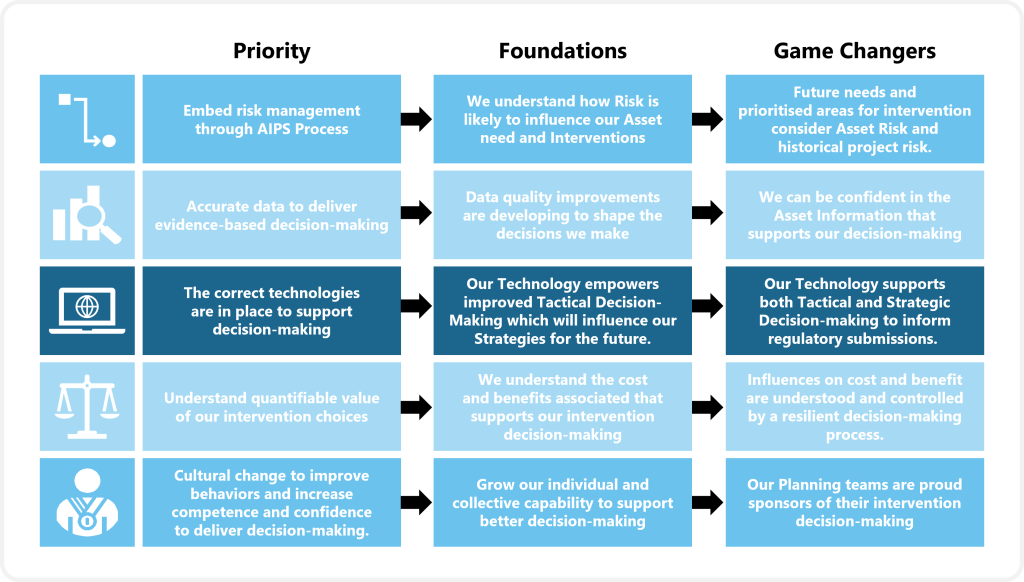
The Asset Investment Planning capability improvement sought to drive incremental enhancement into the preparation of capital investment plans. This growth mindset would be driven by technology and better provision of information to help support the planning teams through an enhanced end-to-end Invest to Outcome process.
This water company first commissioned AMCL to use good practice exemplars from across the water sector to develop a ‘future-state’ capability model and technology requirements in order to drive the business case for Asset Investment Planning enhancement. AMCL were subsequently commissioned to develop a Value Framework to begin to convey ‘common currency’ beyond financial capital within decision making.
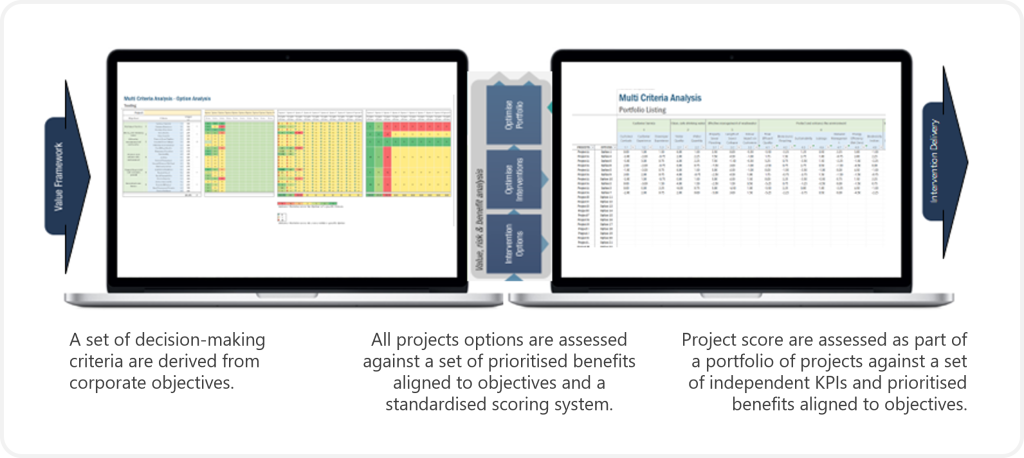
Additionally, AMCL was asked to develop a proof of concept Multi-Criteria Analysis (MCA) tool as an interim staging point to help evaluate intervention and portfolio decision-making. The MCA was aligned to the Value Framework and in tandem, the tool and the framework provide the company with a solid basis for the information maturity journey required to ensure the planned AIP technology enhancement will be immediately beneficial.
AMCL Solution
VALUE FRAMEWORK
We mobilised an experienced team of water sector planning consultants who lead workshops and technology demonstrations to understand the capability landscape within the company more clearly.
It was apparent that there were multiple overlapping improvement activities underway, and AMCL’s capability model and technology requirement developments would help augment and realise some of the benefits associated with these other initiatives.
The capability model and improvement roadmap provided the in-house team with the ability to drive improvements to decision-making processes in the future. With that future state in mind, AMCL was tasked with engaging the leadership opinion on a Value Framework which suited the maturity trajectory and acknowledged that to better embed a decision-making shift, you must first ensure that personnel are comfortable with the approach, and that it is grounded in accessible information that they can immediately connect to.
MCA TOOL
In tandem with the application of value based decision-making, AMCL helped the architects of the Invest to Outcome approach by providing a flexible MCA tool which utilised the Value Framework to evaluate intervention as well as portfolio level prioritisation.
AMCL designed in flexibility to the MCA tool, so that scoring criteria and weighting could all be adjusted as part of the continual improvement approach at the heart of the company.
Key Outcomes & Benefits Delivered
1
A clear view of strengths and opportunities for improvement in the Asset Investment Planning functions;
2
An improvement roadmap that is anchored in the core values of the company with ambitious outcomes and attainable ‘stepping stone’ improvement activity incorporated;
3
A value framework with space to accommodate the decision-making improvement journey that the company is committed to;
4
A set of good practice business and functional requirements with recognisable user journeys for the company personnel to promote effective technology partner engagement activities which is the first step to a great procurement and change implementation;
5
A roadmap of potential improvements that combine the anchored step changes in approach that recognise and then incorporate greater quantification derived from the company’s asset information improvement journey that is concurrently underway; and
6
A proof of concept MCA tool that allows personnel to understand the shifting basis for decision making and incorporates flexibility to allow different teams with their different asset classes to experiment with different evaluation criteria (and supporting asset information).